
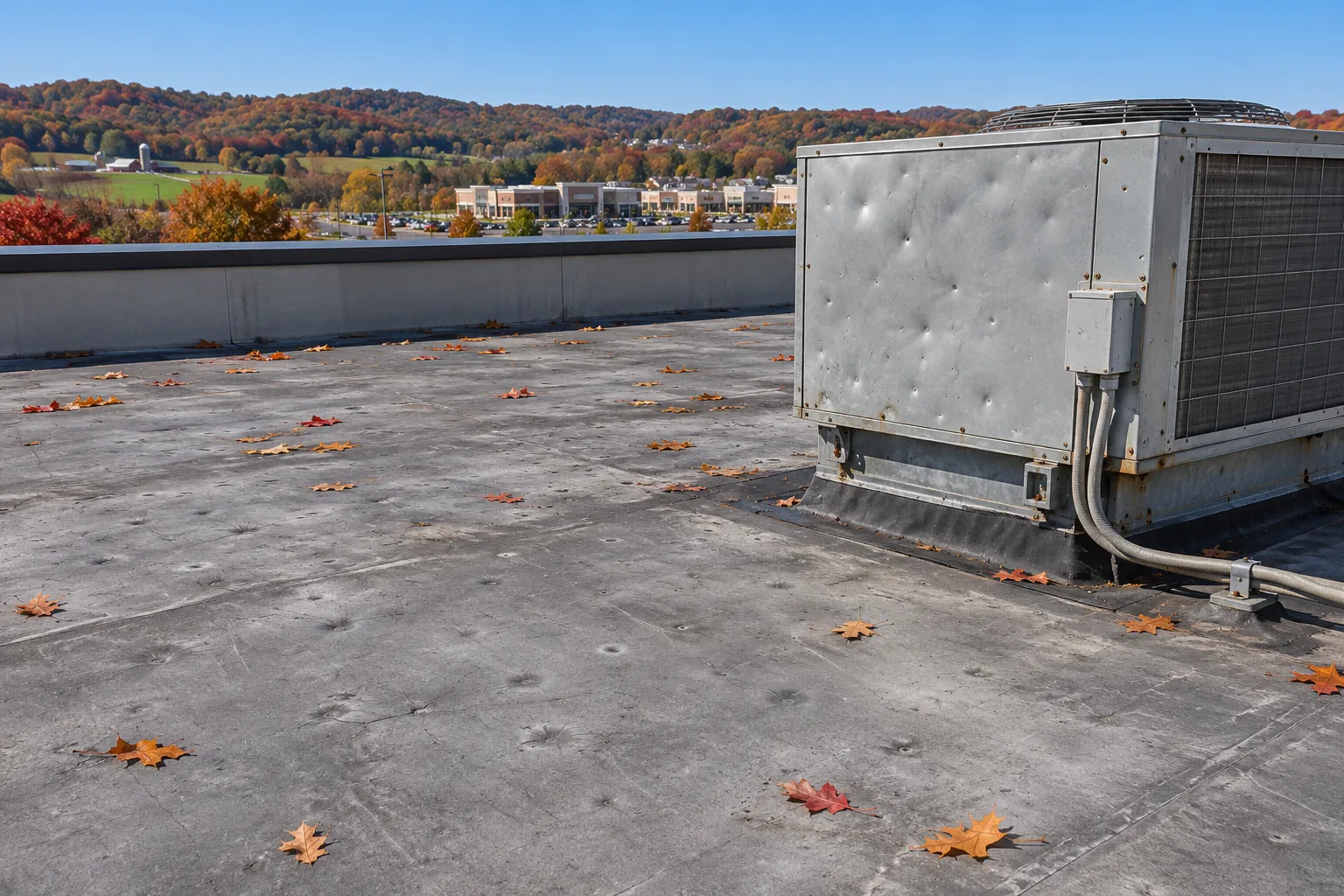
Close view of wear on a commercial roof surface

Commercial Roof Repair Questions in Independence

Find Out Whether Your Roof Problem Calls for a Repair

These commercial roof repair questions in Independence cover leak tracing, flat and metal roof fixes, plant roofs, permits, winter work, and repair costs.

Building owners and facility managers ask us these commercial roof repair questions in Independence most often.

Commercial roof repair is the work of finding and fixing leaks, torn membrane, failed flashing and loose or rusted metal on business, industrial and farm buildings. Independence Commercial Roof Repair fixes flat, metal and industrial roofs across Independence in Kenton County, Kentucky, plus surrounding towns in Grant, Boone, Campbell, Pendleton and Bracken counties.

Commercial Roof Repair Questions in Independence: The Basics

What does a commercial roof repair cover?

A commercial roof repair fixes a defined problem, such as a split seam, torn flashing or a run of loose screws, and leaves the rest of the roof system in place.

Typical repair jobs include:
  • Membrane patches over punctures and splits
  • Reflashing at curbs, walls, pipes and skylights
  • Drain and scupper resets
  • Fastener replacement and lap resealing on metal panels
  • Gutter, edge metal and coping fixes

Wet insulation under a leak gets cut out and replaced as part of the repair, so the soaked boards stop feeding water into the deck.

Repair, restore or replace: which one fits my roof?

Repair fits isolated damage, restoration fits a roof that is aging evenly while staying mostly dry, and replacement fits a roof with widespread wet insulation or failed decking.

PathRoof conditionWhat the work involves
RepairDamage limited to seams, flashing or a few panelsPatch, reflash, refasten
RestoreMembrane or panels worn evenly, insulation mostly dryRepair details, clean, then apply a fluid-applied restoration system
ReplaceWet insulation across large areas, failed deckTear-off or recover with a new system

An infrared scan or a few core cuts settle which path a roof belongs on. Owners often combine paths, repairing a leaking curb now and planning restoration for the next season.

How often should a commercial roof be checked for repairs?

Twice a year, in spring and fall, plus after any major storm, is a common inspection rhythm for commercial roofs. Small problems found early stay small.

Each check covers:
  • Drains, strainers and scuppers for debris
  • Seams and laps for lifting edges
  • Flashing at curbs, walls and parapets
  • Sealant at pitch pans and termination bars
  • Fasteners and panel laps on metal sections

Notes and photos from each visit build a repair history, which makes the next leak easier to trace.

Flat Roof Repair Questions

Which flat roof problems can be repaired?

Flat roof damage that stays in one area can usually be repaired, including punctures, split seams, failed flashing and clogged drains.

Repairable problems include:
  • Punctures from dropped tools, foot traffic or hail
  • Seams opening on TPO, EPDM or PVC
  • Flashing pulling away at walls and curbs
  • Blisters and splits on built-up or modified bitumen
  • Ponding around blocked drains

Once wet insulation spreads well past the leak, a repair only buys time, and the roof moves toward restoration or replacement. A moisture scan shows where that line falls on a given roof.

How are punctures and tears patched on different flat roof membranes?

Each flat roof membrane gets a patch of its own kind, attached the same way as the original sheet.

MembranePatch methodFinished patch
TPOClean, then hot-air weld a TPO patchRounded patch with a welded edge
EPDMClean, prime, apply a peel-and-stick patchRubber patch with rounded corners
PVCClean and weld a PVC patchWelded edge similar to TPO
Modified bitumenTorch or cold-apply a cap sheet patchGranulated patch over the split
Built-up gravelMastic and reinforcing felt, then gravelPatch bedded under gravel

Matching patch to membrane matters, because asphalt mastic softens single-ply sheets and tape made for EPDM bonds poorly to TPO.

Where do flat roof blisters come from, and which ones need repair?

Blisters form when moisture or air trapped between roof plies expands in the sun and lifts the surface, mainly on built-up and modified bitumen roofs.

Treatment follows the blister's condition:
  • Intact, small blisters get marked and watched at each inspection
  • Cracked or broken blisters get cut open, dried and patched
  • Clusters of blisters point to wet insulation and call for a moisture check

Blisters near drains and seams get attention first, since water reaches them fastest. Walking on blisters cracks them, so crews route foot traffic around marked ones.

How is ponding water handled during a flat roof repair?

Ponding gets handled by clearing or resetting the drain first, then adding slope where water still sits days after a rain.

Fixes for ponding:
  • Clearing strainers, debris and silt from drain bowls
  • Resetting a drain that sits higher than the roof around it
  • Building a small tapered cricket or sump at the low spot
  • Adding a scupper at a wall where interior drains fall short

Standing water speeds membrane wear and adds weight to the deck. Ponds spread over large areas lead to a slope review during the next restoration or replacement.

How are failed seams fixed on TPO and EPDM roofs?

Failed TPO seams get cleaned and rewelded, while failed EPDM seams get cleaned, primed and covered with a fresh strip of seam tape.

Seam repair steps:
  • Probe the open lap to find where the bond ends
  • Clean dirt and oxidized film from both sheets
  • Reweld TPO, or prime and tape EPDM with a cover strip
  • Probe again and patch any T-joint in the run

Neighboring seams on the same roof get probed too, because one open lap often signals others aging the same way.

Commercial Metal Roof Repair Questions

Why do commercial metal roofs start leaking?

Metal roofs start leaking mostly at fasteners, laps and trim, where panel movement and aging washers open small gaps.

Common sources on a metal building:
  • Screws backed out by daily expansion and contraction
  • Washers cracked and flattened by sun
  • End laps holding dirt and water
  • Ridge caps and closures loosened by wind
  • Skylight panels cracked at their fasteners
  • Gutters rusted at seams

Panels themselves rarely fail first. Most metal roof repairs start at these small parts and move outward only when rust has spread into the panel field.

How is fastener back-out repaired on a metal roof?

Backed-out fasteners get pulled and replaced with oversized or longer screws carrying new washers, so each screw bites fresh metal in the purlin.

Repair varies by what the crew finds:
  • Tight holes keep their screws, which get new washers and get reseated
  • Stripped holes take the next screw size up
  • Missed-purlin screws get pulled, and each hole gets a stitch screw or sealed patch
  • Over-driven screws with crushed washers get replaced

A torque-limiting driver sets each screw so the washer compresses evenly and seals. Fastener lines get checked along the whole purlin run, since loose screws rarely appear alone.

What decides between patching and replacing a rusted metal roof panel?

Rusted panels can be repaired when the rust stays on the surface or forms a few small holes, and they get replaced once rust eats through wide areas or reaches the purlin bearing.

Repair by rust stage:
  • Surface rust: wire brush, rust-inhibiting primer and sealant at laps
  • Pinholes: cleaned and covered with a metal or reinforced fabric patch
  • Holes across a panel run: new panel, lapped and fastened to match

Replacement panels need the same profile and gauge, so the crew measures rib spacing and height before ordering steel.

How are leaking end laps and side laps repaired?

Leaking laps get cleaned of old sealant and rust, then resealed with butyl tape and stitched tight with new fasteners.

ProblemMetal panel repairMembrane roof repair
Open jointButyl tape and stitch screws at the lapReweld or retape the seam
HoleMetal patch or fabric and sealantMatching membrane patch
Leaking penetrationNew boot and closuresNew pipe boot or flashing
Edge leakRefasten trim, new closuresReset edge metal and strip in

Backup plates at end laps keep the joint tight between purlins on low-slope metal roofs, where water moves slowly across the lap.

How are gutters, ridge caps and trim repaired on metal buildings?

Gutters, ridge caps and trim get repaired by resealing joints, replacing rusted sections and refastening loose pieces so water stays on its path.

  • Gutter seams get cleaned and resealed, with rusted runs replaced
  • Hangers get reset to restore pitch toward downspouts
  • Ridge caps get refastened and fitted with new foam closures
  • Rake and eave trim get screwed back down along loose edges
  • Downspouts get cleared and strapped back to the wall

Loose trim gets fixed early, since wind can peel it away and expose the panel ends to rain.

Commercial Roof Leak Repair Questions

How do you find the source of a commercial roof leak?

Finding a roof leak means tracing water uphill from the interior stain, because water often enters the roof several feet away from where it drips.

Leak tracing steps:
  • Mark the interior drip and measure to the nearest wall or column
  • Locate the same spot on the roof and walk upslope
  • Check seams, flashing, curbs and fasteners in that path
  • Water-test suspect spots one at a time, low to high
  • Confirm wet insulation with a moisture meter or core cut

Infrared scans at dusk show wet insulation over wider areas when a leak resists pinpointing.

Where do leaks usually start on each type of commercial roof?

Each roof type has its own common leak points, and knowing them shortens the search.

Roof typeCommon leak points
TPO or PVCSeam laps, T-joints, curb corners, edge metal
EPDMSeam tape edges, pipe boots, shrinkage at the wall base
Modified bitumenBlisters, split laps, flashing at parapets
Built-up gravelPitch pans, gravel stop edges, cracked flashing
Metal panelFasteners, end laps, ridge caps, skylight panels

Across every type, rooftop units and drains rank high on the list, so crews check them early in any leak call.

Why do leaks keep appearing around rooftop units and curbs?

Rooftop units leak at the curb flashing, the unit's own cabinet panels and the condensate lines, so a curb leak needs all three checked.

  • Curb flashing that is too short or split at the corners
  • Loose or missing cabinet screws letting rain into the unit
  • Condensate lines dripping onto the roof or backing up
  • Crickets missing on the upslope side, so water pools against the curb

HVAC technicians and roof crews working together on one visit sort out whether the roof or the unit owns the leak.

What is a pitch pan, and why does it fail?

A pitch pan is a metal collar around an odd-shaped penetration, filled with pourable sealer where a standard boot is a poor fit.

Pitch pans fail for a few reasons:
  • Sealer shrinks and pulls away from the pipe or steel
  • Old fill cracks and leaves a hollow that holds water
  • Flanges lift from the membrane as the roof moves

Repairs range from topping off with fresh sealer to replacing the pan with a pre-formed boot or a small curb. Structural steel through the roof often gets a curb, which holds up better than a pan.

Can a roof leak be fixed while it is raining?

Crews can slow or stop water during rain with a temporary patch, and the permanent repair waits for a dry, clean surface.

FactorTemporary repairPermanent repair
TimingDuring rain or right after a stormOn a dry day
MaterialsWet-surface mastic, tarps, roof cementMatching membrane, weld, tape or new panels
Surface prepQuick wipe-downCleaned, dried and primed
RoleHolds until the next visitBecomes part of the roof system

Wet insulation under a temporary patch gets cut out during the permanent fix.

Industrial Roof Repair Questions

What makes industrial roof repair different from other commercial repair work?

Industrial roof repairs happen around heavy equipment, process exhaust and plant safety rules, which shape how crews reach and fix the roof.

Plant conditions to plan for:
  • Lockout of exhaust fans before crews work near them
  • Hot-work permits for torch-applied patches
  • Fall protection near skylights and roof edges
  • Access through plant security on approved routes

Residue from the plant often changes which patch materials work, so the crew checks the membrane near stacks before repairing it.

How are roofs repaired around exhaust fans with grease or chemical residue?

Repairs near exhaust fans start with removing residue, since patches and sealants bond poorly to grease- or oil-coated membrane.

Repair sequence:
  • Degrease the area with a cleaner the membrane maker approves
  • Cut out softened or swollen membrane
  • Patch with a sheet rated for the exposure
  • Add a grease containment box or filter under the fan

Fans with steady discharge need containment, or the residue returns to the same spot and softens the new patch.

How do you handle a leak over production lines or stored goods?

A leak over production or inventory gets a temporary dry-in from the roof side first, with the permanent repair scheduled around the plant.

  • Interior catch basins or diverters get set by plant staff
  • Roof crews seal the seam, curb or fastener feeding the leak
  • Mapping logs the leak location against column lines
  • Follow-up repairs happen once the surface dries

Column-line notes help the crew find the same spot later on a large roof, where one drain bay looks much like the next.

How are industrial roof repairs scheduled around shifts and shutdowns?

Industrial roof repairs fit into shift changes, weekend shutdowns or planned maintenance windows, set with the plant's maintenance and safety leads.

Scheduling items:
  • Lockout times for fans and make-up air near the repair
  • Crane or lift slots that avoid dock traffic
  • Odor control for adhesives near air intakes
  • Sign-in, badge and escort rules

Small repairs at fasteners or seams often fit into a single shift, while reflashing a large curb or skylight row can span a planned shutdown.

How are skylights and expansion joints repaired on industrial roofs?

Skylights and expansion joints get repaired by resealing or replacing their flashing and covers, since both sit where the roof moves and opens.

  • Skylight curbs get reflashed, and cracked domes get replaced
  • Safety screens over skylights get checked during the visit
  • Expansion joint bellows get replaced where split or brittle
  • Joint covers get refastened along loose runs

Cracked smoke vents get the same attention, since a broken vent lid lets rain straight into the building.

Have a Question About Your Own Roof?

Every roof is different. Call with the roof type and what you are seeing, and we will tell you plainly whether it looks like a repair job.

  • Plain answers
  • Inspection when needed
  • Free estimates

Independence Commercial Roof Repair Questions on Weather, Permits and Codes

What storm damage should be checked on a commercial roof after severe weather?

After a severe storm, check edge metal, flashing, drains and the membrane surface for wind lift, hail strikes and debris punctures.

  • Edge metal and coping lifted or bent at corners
  • Hail bruises that show as dents in metal or soft spots in membrane
  • Punctures from limbs or blown debris
  • Drains clogged with leaves and gravel
  • Skylight domes cracked or loose

Dated photos support an insurance claim, and coverage questions go to the carrier and adjuster. Temporary patches right after the storm limit interior damage while the claim moves forward.

When does a roof repair around Independence call for a building permit?

Permit needs grow with the size of a repair, so call the building office before work that replaces decking, swaps panels across a roof section or moves rooftop units.

AreaOffice for roof repair questions
Independence (Kenton)City inspection office, with commercial work assigned to PDS of Kenton County
Walton (Boone)Walton's city offices and Boone County officials
Alexandria (Campbell)Alexandria's offices or Campbell County building inspections
Crittenden and Dry Ridge (Grant)Each city plus the Grant County inspector
Falmouth (Pendleton)State DHBC for commercial construction

The state publishes a contact sheet per county listing each local office. Have photos of the damaged seams, flashing or panels ready when calling.

Which Kentucky codes come into play on a commercial roof repair?

Commercial roof repairs in Kentucky fall under the 2018 Kentucky Building Code, the state's edition of the 2015 International Building Code, as listed by the Kentucky Department of Housing, Buildings and Construction.

That same list names the 2012 IECC as the commercial energy code. Repairs that replace roof insulation over a large area raise energy code questions worth asking the building office.

Code points that touch repair work:
  • Fire classification of patch materials on rated roofs
  • Edge metal reattachment that resists wind
  • Recover limits when a repair grows into a new roof layer

What changes about roof repairs in an Independence winter?

Winter repairs near Independence focus on stopping active leaks, because cold, ice and snow limit which sealants, adhesives and welds can be applied.

  • Snow gets cleared from the work area to expose seams and flashing
  • Ice at drains and gutters gets broken up so water can leave the roof
  • Temporary patches hold until a warmer, dry day
  • Cold-weather tapes and primers go on within their listed temperature range

Freeze-thaw cycles widen small splits in membrane and sealant, so fall repairs before the first hard freeze head off bigger leaks.

Independence Commercial Roof Repair Questions on Cost and Taxes

Why do two commercial roof repairs of similar size cost different amounts?

Two similar-looking repairs land at different costs because leak tracing time, roof type, wet insulation and access change from roof to roof.

Cost factors:
  • Leak tracing time on roofs with several possible sources
  • Roof type and patch materials, from TPO welds to metal panels
  • Wet insulation that needs cutting out
  • Access by ladder, lift or interior hatch
  • Number of repairs bundled into one visit
  • Night or weekend work for occupied plants

Grouping several small repairs, such as loose flashing and a clogged drain, into one trip lowers the cost per repair compared with separate visits.

When do repeated repairs stop making sense on a commercial roof?

Repairs stop paying off when leaks return in new places each season and moisture scans show wet insulation spreading.

Warning signs in the repair history:
  • Records showing the same roof area patched again and again
  • Wet insulation found over a growing share of the roof
  • Seams or fasteners failing across the whole field
  • Repair spending in recent years approaching the cost of restoration

At that point, restoration or replacement belongs in the conversation, starting with a moisture survey of the full roof.

Can roof repair costs be deducted, and where does Section 179 fit?

Ordinary roof repairs and roof improvements get different tax treatment, and IRS Publication 946 lists roofs among the improvements to nonresidential buildings that can qualify for Section 179.

For 2026, Section 179 allows up to $2,560,000, reduced dollar for dollar once qualifying purchases go past $4,090,000.

Questions for a CPA:
  • Repair or improvement classification for each job
  • Nonresidential status of the building
  • Date the work was placed in service
  • Invoices describing the panels, seams or flashing involved

A CPA should review the work before any deduction is claimed.

Questions by Town

Which office reviews roof repair work in Independence, KY?

Repair permit questions in Independence start with the city's building inspection office, and Kentucky's Kenton County contact sheet assigns commercial inspections in the city to Planning and Development Services of Kenton County.

Call ahead of repairs that replace deck, swap panels across a roof section, or move a rooftop unit to fix the curb under it.

Useful items for that call:
  • Photos of the damaged seams, flashing or panels
  • Roof square footage and system type
  • Building use and occupancy

What roof repairs come up on Independence buildings along KY 17?

Buildings along the KY 17 corridor in Independence range from older metal shops and barns to newer low-slope commercial buildings, so repair calls cover both panel roofs and membranes.

BuildingCommon repair
Older metal shops and barnsBacked-out screws, rusted end laps, cracked skylight panels
Newer low-slope buildingsSeam and curb leaks, clogged drains, ponding
Mixed buildings with additionsTransition flashing where metal meets membrane

Matching patch materials to each roof system keeps repairs compatible with what is already there.

Is Walton or Boone County the right call for a roof repair permit?

Walton's city government sets local building and zoning rules through Title XV of its code of ordinances, and owners should ask city staff whether Boone County building officials inspect the repair.

Walton lies near the point where I-71 branches off I-75, just inside Boone County from the Kenton line. Long low-slope roofs on large buildings there tend to show:
  • Seam stress at the middle of long membrane runs
  • Clogged drains far from the roof edge
  • Loose edge metal along wide, exposed walls

A quick look at the tax bill confirms the county before any permit call.

Where should Alexandria owners ask about commercial roof repair permits?

Alexandria owners can ask the city or Campbell County Planning, Zoning and Building Inspections; the county's web pages carry permit forms and fee lists. Parcels inside and outside city limits mix along the US 27 corridor, so the right office depends on the address.

Repair details the office wants to hear:
  • Whether decking or panels get replaced
  • Changes at rooftop units, coping or roof edges
  • Photos of the leak area and its flashing

Small patch work rarely changes the roof's structure, but confirming first avoids a stop-work surprise.

How does rural power service affect roof repairs near Crittenden?

Rural properties around Crittenden draw power from Owen Electric Cooperative, one of the East Kentucky Power Cooperative owner-members, or from Duke Energy Kentucky, and that service matters when a curb repair means disconnecting a rooftop unit.

Crittenden is a Grant County city, and the state's Grant County contact sheet lists the county's local building inspector for repairs that reach beyond simple patching.

A curb repair with power involved runs in order:
  • Electricians handle the disconnect and reconnect
  • Crews reflash the curb while the unit is down
  • Startup follows once the flashing is sealed

How do Dry Ridge businesses near I-75 schedule roof repairs?

Dry Ridge businesses near the KY 22 and I-75 interchange schedule roof repairs around customer hours, since restaurants, lodging and retail stay busy through the day.

Repair scheduling there covers:
  • Early starts before dining rooms and lobbies fill
  • Grease cleanup around kitchen exhaust fans before patching
  • Lift placement away from drive lanes and entrances
  • Quick dry-ins over guest rooms when rain moves in

Permit questions for larger repairs go to the city or the Grant County inspector.

What roof repairs follow high water in Falmouth, KY?

After high water in Falmouth, roof repairs focus on silt-filled gutters and drains, wet insulation at low roof sections, and flashing along lower walls. The town sits where the South Fork of the Licking joins the main river, which puts low buildings near flood-prone ground.

  • Silt and debris get flushed from gutters and drain bowls
  • Wet insulation near walls gets cut out and replaced
  • Counterflashing along lower wall lines gets resealed

Commercial construction across Pendleton County goes to the state's housing and buildings department, per the Pendleton County contact sheet, and the county's inspections page covers electrical work at rooftop units.

Which other towns around Independence does the repair crew cover?

Repair work reaches seven more towns around Independence, each tied to its own county permit office.

TownCountyPermit office to ask
Taylor MillKentonPDS of Kenton County
Morning ViewKentonMorning View city offices or PDS of Kenton County
VeronaBooneBoone County building officials
CaliforniaCampbellCampbell County inspections, per the state's Campbell sheet
ButlerPendletonState DHBC for commercial work
DemossvillePendletonState DHBC for commercial work
FosterBrackenState DHBC for commercial work

Repair calls in each town get the same leak tracing at seams, flashing and fasteners.

Getting Started

What should I tell a repair crew about my roof leak?

Timing, location and recent rooftop work are the details that shorten a leak search the most.

Helpful details:
  • When the leak shows up: during rain, after snowmelt, or with wind from one direction
  • Interior photos of stains, drips and wet ceiling tiles
  • Location of the drip relative to columns or walls
  • Recent rooftop work by HVAC or electrical contractors
  • Roof type and age, if known
  • Past repair records

Leaks that appear only with wind-driven rain often point to edge metal, coping or wall flashing.

What happens during a commercial roof repair visit?

A repair visit starts with tracing the leak or damage and moves to the repair once the source is confirmed.

During the visit, Independence Commercial Roof Repair:
  • Inspects seams, flashing, drains, fasteners and curbs near the reported problem
  • Photographs damage before and after the work
  • Makes the repair once the source is confirmed and the surface is dry
  • Notes other roof issues spotted during the walk

Owners get plain answers about what failed, what was fixed and what to watch next.

Still Have Commercial Roof Repair Questions in Independence?

Call with the roof type and where water shows up, or request an estimate and we will inspect the problem area.

Call Us +1 (513) 775-5303